A man buys an expensive product, only to discover later that it has serious flaws. Instead of admitting he made a poor choice, he starts focusing on its positive features and ignores the negatives. Most of us have done something similar at some point, often without realizing it. This everyday behavior sits at the heart of one of psychology’s most fascinating concepts: cognitive dissonance.
When creating a mind map summarizing one psychology concept, cognitive dissonance is an excellent place to start because it connects thoughts, emotions, beliefs, decisions, and behavior into one interconnected system. It helps explain why people defend opinions despite evidence, justify questionable choices, and sometimes act in ways that seem irrational from the outside.
The concept remains highly relevant because it appears in relationships, politics, consumer behavior, education, and personal growth. Once you understand how cognitive dissonance works, you begin noticing its influence almost everywhere.
What Is Cognitive Dissonance?
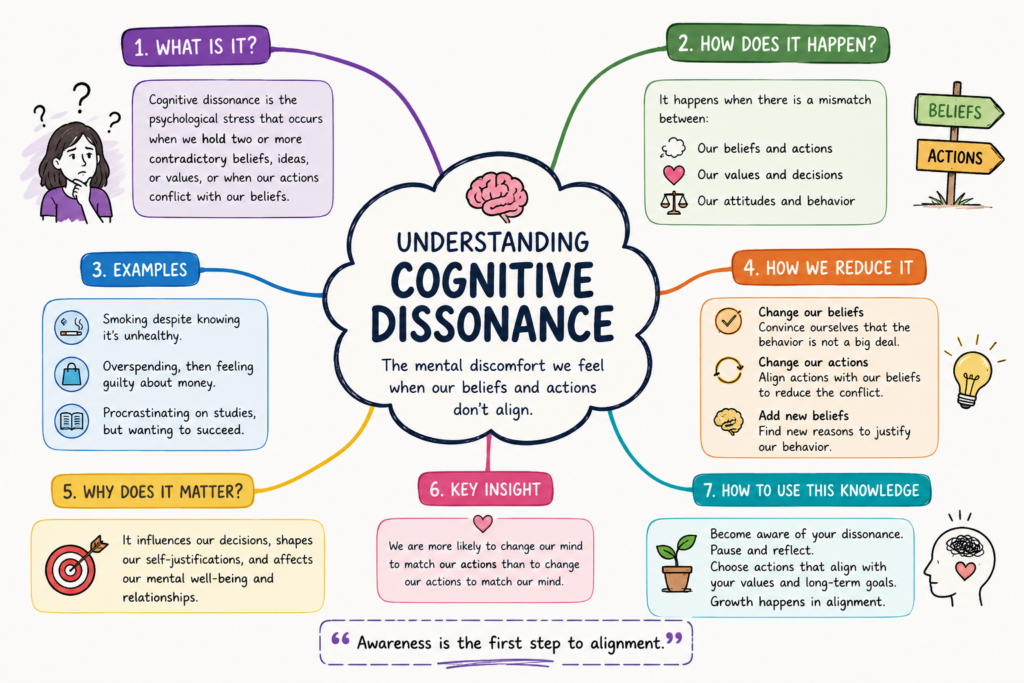
The phrase cognitive dissonance refers to the mental discomfort that occurs when a person holds conflicting beliefs, attitudes, or behaviors. Humans naturally prefer consistency. When our actions and beliefs align, we experience psychological harmony. When they clash, tension emerges.
Psychologist Leon Festinger introduced the theory in the 1950s after observing how people often change their beliefs to reduce psychological discomfort. Rather than accepting contradictions, the mind searches for ways to restore balance.
Imagine someone who values health but regularly smokes cigarettes. The conflict between the belief that smoking is harmful and the behavior of smoking creates dissonance. That uncomfortable feeling motivates the person to resolve the contradiction somehow.
This is why a mind map summarizing one psychology concept often places cognitive dissonance at the center, with multiple branches extending outward to thoughts, emotions, behavior, and decision-making.
The Core Components of a Cognitive Dissonance Mind Map
At the center of the mind map sits cognitive dissonance itself. From there, several interconnected elements emerge.
The first branch involves beliefs. These are the ideas people hold about themselves, others, and the world. Beliefs often shape identity, making them particularly resistant to change.
The second branch focuses on behavior. Every action a person takes can either support or challenge existing beliefs. When behavior contradicts beliefs, psychological tension increases.
The third branch represents emotions. Cognitive dissonance frequently generates feelings of discomfort, guilt, anxiety, regret, or frustration. These emotions act as signals that something feels psychologically inconsistent.
The fourth branch relates to justification. People often create explanations to reduce discomfort without changing their behavior. This process helps restore a sense of internal consistency.
The final branch connects to attitude change. Sometimes individuals modify their beliefs rather than their actions. This adjustment reduces dissonance and creates a more coherent self-image.
Together, these elements form a powerful framework for understanding human behavior.
Why the Brain Dislikes Contradictions
The human brain is remarkably efficient, but it also craves consistency. When information fits neatly into existing beliefs, processing becomes easier. Contradictory information requires additional mental effort.
Researchers believe consistency helps people maintain a stable sense of identity. Most individuals want to see themselves as rational, competent, and morally consistent. Evidence that challenges this self-image can feel threatening.
For example, a person who sees themselves as environmentally conscious may feel uncomfortable driving a highly polluting vehicle. That discomfort creates pressure to either change the behavior or reinterpret its significance.
I’ve found that many people assume they make decisions based purely on logic. In reality, emotional comfort often plays a significant role. Cognitive dissonance demonstrates that maintaining psychological consistency can sometimes become more important than objective accuracy.
Cognitive Dissonance in Everyday Life
One reason a mind map summarizing one psychology concept becomes useful is that it reveals how a theory applies to daily experiences.
Shopping provides a common example. After making a costly purchase, people frequently seek information that confirms they made the right decision. Positive reviews become more persuasive, while negative reviews are often dismissed.
Relationships offer another example. Individuals may overlook warning signs in a partner because acknowledging those issues would conflict with their belief that they made a good choice.
Workplace decisions also involve cognitive dissonance. Employees who invest years in a demanding career may justify dissatisfaction by emphasizing future rewards. Admitting they chose the wrong path can create significant psychological discomfort.
Even social media reflects this process. People tend to engage with content that supports their existing views while avoiding information that challenges them. This behavior helps reduce dissonance but can also reinforce biases.
How People Reduce Cognitive Dissonance
The discomfort created by cognitive dissonance rarely remains unresolved. People typically attempt to reduce it through various psychological strategies.
One common approach involves changing behavior. A smoker concerned about health risks may decide to quit smoking. By aligning behavior with beliefs, the conflict disappears.
Another strategy involves changing beliefs. Instead of quitting, the smoker might convince themselves that health risks are exaggerated. This adjustment reduces tension without requiring behavioral change.
A third approach involves adding new justifications. Someone who overspends on a luxury item may focus on its long-term value or emotional benefits. These explanations help balance the psychological equation.
The mind often selects whichever solution requires the least effort. That tendency explains why behavioral change can be difficult even when people recognize contradictions in their lives.
Cognitive Dissonance and Decision-Making
Decision-making represents one of the most interesting branches in a mind map summarizing one psychology concept centered on cognitive dissonance.
Every major decision involves alternatives. Once a choice is made, people naturally focus on its advantages while minimizing the appeal of rejected options. Psychologists call this post-decision dissonance.
Imagine choosing between two job offers. After accepting one position, you may emphasize its strengths and downplay the benefits of the opportunity you declined. This mental adjustment helps reduce uncertainty and regret.
The same pattern appears when selecting universities, homes, cars, or romantic partners. The larger the decision, the stronger the potential for cognitive dissonance.
Understanding this process can improve decision-making because it encourages people to evaluate choices more objectively rather than relying solely on psychological self-protection.
The Influence of Cognitive Dissonance on Society
Cognitive dissonance extends beyond individual behavior and influences entire groups and societies.
Political beliefs provide a clear example. When individuals strongly identify with a political ideology, contradictory evidence may create discomfort. Rather than changing opinions, people often reinterpret information in ways that support existing views.
The same dynamic appears in sports fandom, religious beliefs, and cultural traditions. Group identity can strengthen cognitive dissonance because changing a belief may feel like betraying a community.
Marketing professionals also understand the concept well. Advertising campaigns often reinforce consumer decisions after purchase, helping customers feel satisfied with their choices and reducing post-purchase dissonance.
These examples show how a single psychological theory can influence everything from personal habits to large-scale social behavior.
Using Cognitive Dissonance for Personal Growth
Understanding cognitive dissonance can become a powerful tool for self-improvement. Instead of viewing discomfort as a problem, it can be seen as valuable information.
When tension arises between beliefs and actions, it creates an opportunity for reflection. The discomfort may reveal habits that no longer align with personal values or goals.
For example, someone who values honesty but notices frequent exaggeration may experience cognitive dissonance. Rather than ignoring the feeling, they can use it as motivation for positive change.
In my experience, personal growth often begins when people become willing to sit with discomfort instead of immediately explaining it away. That willingness creates space for genuine self-awareness.
The more we understand our psychological tendencies, the easier it becomes to make conscious choices rather than automatic ones.
A Mind Map Summarizing One Psychology Concept and Why It Matters
A mind map summarizing one psychology concept becomes especially effective when built around cognitive dissonance because the theory connects so many aspects of human behavior. Thoughts influence emotions, emotions affect decisions, decisions shape actions, and actions often reshape beliefs.
This interconnected structure makes cognitive dissonance one of the most practical concepts in psychology. It explains why people justify mistakes, defend opinions, and sometimes resist change even when evidence points in another direction.
The next time you catch yourself rationalizing a decision or defending a belief despite conflicting facts, pause for a moment. You may be witnessing cognitive dissonance in action. Understanding that process does more than satisfy curiosity. It offers a clearer view of how the mind works and opens the door to more thoughtful, intentional choices.
Daily Dose of Psychology
Here’s a fascinating psychological insight: when people experience discomfort because their actions don’t match their beliefs, they often change their attitudes rather than their behavior. This phenomenon is called cognitive dissonance. The next time you find yourself defending a decision you’ve already made, pause and ask yourself whether you’re evaluating the facts objectively or simply trying to reduce psychological discomfort. That small moment of self-awareness can reveal a lot about how the human mind works.