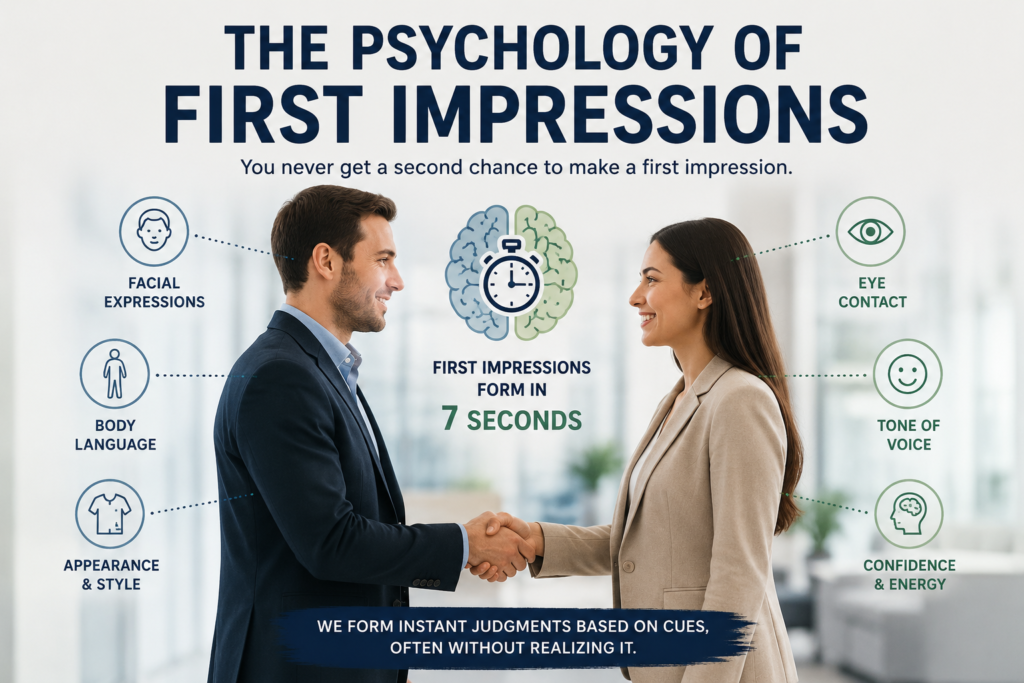
First impressions happen faster than most people realize. Within moments of meeting someone, our brains begin forming opinions about their trustworthiness, competence, confidence, and personality. Those snap judgments often feel automatic, yet they can influence relationships, job opportunities, friendships, and even major life decisions. The psychology of first impressions reveals that while these instant evaluations can be surprisingly powerful, they are also far from perfect.
Think about the last time you met someone new. Before a full conversation even began, you probably noticed their facial expressions, body language, clothing, voice, and overall demeanor. Your brain quietly collected these details and started building a story. In many cases, that story shaped your expectations before the other person had a chance to reveal who they really were.
Understanding why first impressions occur and how they affect human behavior can help us navigate social situations more effectively. It can also make us more aware of our own biases and assumptions.
Why First Impressions Form So Quickly
From an evolutionary perspective, rapid judgments served an important purpose. Early humans often had limited time to decide whether another person represented a threat, an ally, or a potential source of support. The ability to assess situations quickly increased the chances of survival.
Although modern life is very different, our brains still rely on similar mental shortcuts. Psychologists often refer to these shortcuts as heuristics. Rather than carefully analyzing every piece of information, the brain uses available cues to make fast predictions about people and situations.
Research has shown that people can form impressions of strangers within a fraction of a second. Facial features, eye contact, posture, and emotional expressions all contribute to these judgments. Even when individuals believe they are being objective, unconscious processes often influence their perceptions.
I’ve found that many people are surprised to learn how little information is required for these judgments to occur. We like to think we reserve judgment until we know someone, yet our minds are constantly making assessments behind the scenes.
The Role of Appearance in First Impressions
Physical appearance plays a significant role in the psychology of first impressions. This does not mean attractiveness is everything, but visual cues often shape initial perceptions before words are exchanged.
One well-known phenomenon is the halo effect. When someone possesses one positive characteristic, such as an attractive appearance or a warm smile, observers may assume they also possess other desirable traits. They might be perceived as more intelligent, trustworthy, or capable, even without evidence to support those assumptions.
Clothing also communicates information. People frequently make judgments based on how someone dresses, whether consciously or unconsciously. Professional attire may create an impression of competence, while casual clothing can suggest approachability depending on the setting.
These reactions happen so naturally that we rarely stop to question them. Yet appearance-based judgments can lead to inaccurate conclusions. A polished appearance does not guarantee strong character, and a casual presentation does not indicate a lack of ability.
Body Language Speaks Before Words
Long before meaningful conversation begins, nonverbal communication starts sending signals. Body language can strongly influence the psychology of first impressions because people instinctively look for clues about confidence, openness, and emotional state.
Posture often shapes perceptions. Someone standing upright with relaxed shoulders may appear confident and self-assured. On the other hand, slouched posture can sometimes be interpreted as insecurity or disinterest, even when that interpretation is inaccurate.
Eye contact is another powerful factor. Appropriate eye contact tends to communicate engagement and sincerity. Too little eye contact may create an impression of nervousness, while excessive eye contact can feel intimidating or uncomfortable.
Facial expressions contribute just as much. A genuine smile often creates feelings of warmth and trust, helping social interactions start on a positive note. People are naturally drawn to expressions that signal friendliness and emotional safety.
The fascinating part is that many of these cues operate beneath conscious awareness. We notice them without realizing we are noticing them.
The Psychology Behind Snap Judgments
The psychology of first impressions is closely connected to cognitive efficiency. Human brains process enormous amounts of information every day. To avoid becoming overwhelmed, they simplify reality through categorization and pattern recognition.
When meeting someone new, the brain compares available information to previous experiences and existing mental models. This process allows quick decision-making, but it also creates opportunities for bias.
Confirmation bias frequently enters the picture. Once an initial impression forms, people often seek information that confirms their first judgment while overlooking contradictory evidence. If someone is initially perceived as competent, mistakes may be excused more easily. If they are viewed negatively, the same mistakes may receive harsher scrutiny.
This tendency helps explain why first impressions can be so persistent. The brain prefers consistency and often resists information that challenges its original assessment.
How First Impressions Affect Professional Success
Few environments highlight the importance of first impressions more clearly than the workplace. Job interviews, networking events, client meetings, and leadership opportunities all involve rapid evaluations.
Recruiters frequently form preliminary opinions within the first few minutes of an interview. While qualifications and experience remain critical, communication style, confidence, and professionalism often influence how candidates are perceived.
Business relationships operate in a similar way. Clients and colleagues may decide whether someone appears trustworthy or competent before detailed discussions even begin. These early perceptions can affect collaboration, promotions, and long-term career growth.
In my experience, many professionals underestimate the impact of seemingly small behaviors. Arriving on time, maintaining positive body language, listening attentively, and speaking clearly can significantly shape how others perceive competence and reliability.
That does not mean people should become overly concerned with image. Authenticity still matters. The goal is not to create a false persona but to ensure that outward behavior accurately reflects one’s abilities and intentions.
Can First Impressions Be Changed?
One of the most common misconceptions about the psychology of first impressions is that they are permanent. While initial judgments are powerful, they are not necessarily fixed.
Over time, consistent behavior can reshape perceptions. If someone makes a poor first impression but repeatedly demonstrates competence, kindness, or reliability, others often revise their opinions. The process may take effort, but it is entirely possible.
Research suggests that negative first impressions can be particularly difficult to overcome because people tend to pay more attention to potential threats or problems. This tendency, known as negativity bias, means unfavorable judgments sometimes linger longer than positive ones.
Fortunately, human relationships involve ongoing interaction rather than isolated moments. Every conversation, action, and experience provides additional information that can strengthen or weaken earlier assumptions.
People often remember the first chapter of a story, but they also continue reading. That reality offers hope for anyone worried about a less-than-perfect introduction.
Cultural Differences in First Impressions
Although certain aspects of first impressions appear universal, cultural expectations can influence how people evaluate one another.
In some cultures, direct eye contact is viewed as a sign of confidence and honesty. In others, it may be interpreted as disrespectful or overly aggressive. Personal space, greetings, gestures, and communication styles can also carry different meanings across societies.
These differences remind us that first impressions do not exist in a vacuum. Context matters. Behaviors that create positive impressions in one environment may produce entirely different reactions elsewhere.
As workplaces and communities become increasingly global, cultural awareness plays an essential role in effective communication. Understanding these variations can reduce misunderstandings and foster stronger connections.
Becoming More Aware of Your Own Judgments
Learning about the psychology of first impressions is not only about influencing how others perceive us. It is equally about understanding how we perceive others.
Everyone forms snap judgments. The challenge lies in recognizing when those judgments may be incomplete or inaccurate. Taking time to gather additional information can lead to fairer evaluations and better decisions.
One useful habit is pausing before drawing firm conclusions about someone. Initial impressions provide data, but they rarely tell the whole story. Curiosity often reveals details that first impressions miss.
I’ve noticed that some of the most interesting and valuable relationships begin with assumptions that later prove wrong. People are complex, and a few seconds of observation can never fully capture who they are.
The Lasting Power of First Impressions
The psychology of first impressions continues to fascinate researchers because it sits at the intersection of perception, emotion, and social behavior. These rapid judgments help us navigate daily life, yet they also expose the shortcuts and biases built into human thinking.
Whether we’re meeting a potential employer, making a new friend, or encountering a stranger, first impressions influence the path of the interaction. They can open doors, create obstacles, and shape expectations long before deeper understanding develops.
The good news is that awareness changes everything. The more we understand the psychology of first impressions, the better equipped we become to present ourselves authentically and evaluate others more thoughtfully. Every new interaction offers an opportunity to look beyond the surface and discover the person behind the first glance.
Daily Dose of Psychology
Here’s a fascinating psychological insight: people often decide whether they trust someone within seconds of meeting them, and that judgment can influence how they interpret everything that follows. Psychologists call this the “primacy effect,” which means early information tends to carry more weight than later information. The next time you meet someone new, pay attention to your immediate assumptions. You may discover that your first impression says as much about your own mental shortcuts as it does about the person standing in front of you.