Human beings like to think they make decisions based on logic and careful reasoning. Yet psychology has repeatedly shown that our minds take shortcuts. These shortcuts help us process information quickly, but they can also lead us astray in surprising ways. The result is what psychologists call cognitive biases, predictable patterns of thinking that can distort judgment and influence choices without us even realizing it.
I’ve found that learning about cognitive biases changes the way you see everyday life. Suddenly, political debates, shopping decisions, workplace disagreements, and even personal relationships start making more sense. Many of the misunderstandings and poor decisions we witness are not caused by a lack of intelligence. Instead, they often stem from the hidden mental habits that shape how people interpret the world.
Among the dozens of documented biases, a few appear so frequently that they affect nearly everyone. Understanding these common cognitive biases is one of the best ways to improve critical thinking and make more balanced decisions.
Confirmation Bias
Confirmation bias is perhaps the most well-known and influential cognitive bias. It occurs when people actively seek, interpret, and remember information that supports their existing beliefs while ignoring or dismissing evidence that challenges them. The mind naturally prefers consistency, which makes contradictory information uncomfortable.
Imagine someone who strongly believes a particular diet is the healthiest option. When they read articles praising that diet, they immediately accept the information as credible. When they encounter research highlighting potential drawbacks, they may question the source or disregard the findings altogether. The same pattern appears in politics, sports fandom, investing, and countless other areas of life.
What makes confirmation bias particularly powerful is that it often operates beneath conscious awareness. Most people genuinely believe they are evaluating evidence fairly. In reality, they are unconsciously filtering information through their existing worldview.
In my experience, one of the simplest ways to reduce confirmation bias is to intentionally seek opposing viewpoints. Reading arguments from both sides of an issue can feel uncomfortable at first, but it often reveals weaknesses in assumptions that would otherwise go unnoticed. The goal is not necessarily to change your mind but to ensure your beliefs are based on a complete picture rather than selective evidence.
Anchoring Bias
The first piece of information we receive often has a stronger influence on our judgment than we realize. Psychologists refer to this tendency as anchoring bias. Once an initial reference point is established, later decisions tend to revolve around that anchor, even when it has little relevance.
A classic example appears in retail pricing. If a jacket is displayed with an original price of $300 and then marked down to $150, many shoppers perceive it as an incredible bargain. The original price becomes the anchor, making the discounted price appear more attractive. Whether the jacket was ever truly worth $300 is often overlooked.
Anchoring bias extends far beyond shopping. Salary negotiations, real estate transactions, and business deals frequently involve anchoring effects. The first number introduced into a discussion often shapes expectations and influences the final outcome.
Even experts are vulnerable to anchoring. Studies have shown that professionals in fields such as medicine and law can be affected by initial information when making judgments. This highlights how deeply rooted the bias is in human cognition.
Becoming aware of anchors can help reduce their influence. When evaluating a decision, it helps to pause and ask whether the starting point is genuinely relevant or simply the first piece of information encountered. That brief moment of reflection can lead to a more objective assessment.
Availability Heuristic
The availability heuristic is a cognitive bias that causes people to judge the likelihood of events based on how easily examples come to mind. If something is memorable, dramatic, or frequently discussed, we tend to assume it occurs more often than it actually does.
News coverage provides a clear illustration. After hearing multiple reports about airplane accidents, some people become more fearful of flying. Yet statistically, commercial aviation remains one of the safest forms of transportation. The vividness of the stories makes those rare events feel far more common than they truly are.
This bias influences risk perception in many areas of life. People often overestimate dangers that receive extensive media attention while underestimating more common risks that receive little coverage. As a result, decisions may be driven by emotional impressions rather than accurate probabilities.
Social media has amplified this effect. Algorithms frequently highlight content that generates strong reactions, making unusual events appear widespread. When the same type of story appears repeatedly in a person’s feed, the brain interprets it as evidence of a larger trend.
One useful strategy is to look beyond personal impressions and seek reliable statistics. Data often tells a different story than memory. While intuition has value, combining it with objective information creates a more balanced perspective.
The Dunning-Kruger Effect
Few common cognitive biases are as fascinating as the Dunning-Kruger effect. This bias occurs when individuals with limited knowledge or skill in a particular area overestimate their competence. Ironically, the very lack of expertise that causes mistakes also makes it difficult to recognize those mistakes.
Most people have encountered this phenomenon at some point. A beginner may feel highly confident after learning the basics of a subject, believing they understand far more than they actually do. As their knowledge grows, they begin to recognize the complexity of the field and often become less certain about their conclusions.
The effect can be observed in workplaces, online discussions, and everyday conversations. Individuals with minimal experience sometimes express extreme confidence, while genuine experts may communicate with greater caution because they understand the nuances and limitations involved.
This does not mean confidence is inherently bad. Confidence can motivate learning and action. Problems arise when confidence becomes disconnected from competence. Poor decisions are more likely when people assume they know enough and stop seeking additional information.
Personally, I’ve found that the best defense against the Dunning-Kruger effect is intellectual humility. Recognizing that there is always more to learn creates room for growth. Asking questions, welcoming feedback, and remaining open to correction are habits that strengthen judgment over time.
Hindsight Bias
After an event occurs, people often convince themselves they knew the outcome all along. This tendency is known as hindsight bias. Once the result becomes clear, the uncertainty that existed beforehand tends to disappear from memory.
Consider a major business failure or a surprising election result. After the outcome is revealed, countless observers claim the signs were obvious. Yet before the event occurred, many of those same individuals expressed uncertainty or even predicted a different outcome.
Hindsight bias creates the illusion that events are more predictable than they really are. This can lead people to underestimate risk and overestimate their ability to forecast future outcomes. It also encourages unfair judgments of decisions made under uncertain circumstances.
The bias affects learning because it distorts memories of past thinking. When people believe they “knew it all along,” they miss opportunities to examine why their original predictions may have been inaccurate. Growth requires an honest assessment of what was known before the outcome occurred.
Keeping records of decisions can help counter hindsight bias. Writing down expectations before a significant event creates an objective reference point. Later, it becomes easier to compare predictions with reality and identify lessons that might otherwise be overlooked.
Why Understanding Cognitive Biases Matters
The most common cognitive biases influence far more than isolated decisions. They shape relationships, careers, financial choices, and social interactions. Left unchecked, they can reinforce misconceptions and create blind spots that limit personal growth.
The encouraging news is that awareness alone can make a meaningful difference. Cognitive biases are deeply embedded in human thinking, so eliminating them entirely is unrealistic. Even trained psychologists remain susceptible to many of the same mental shortcuts they study. The goal is not perfection but improvement.
When we recognize these patterns, we become more thoughtful decision-makers. We learn to question first impressions, evaluate evidence more carefully, and remain open to alternative perspectives. Those habits often lead to better outcomes in both personal and professional life.
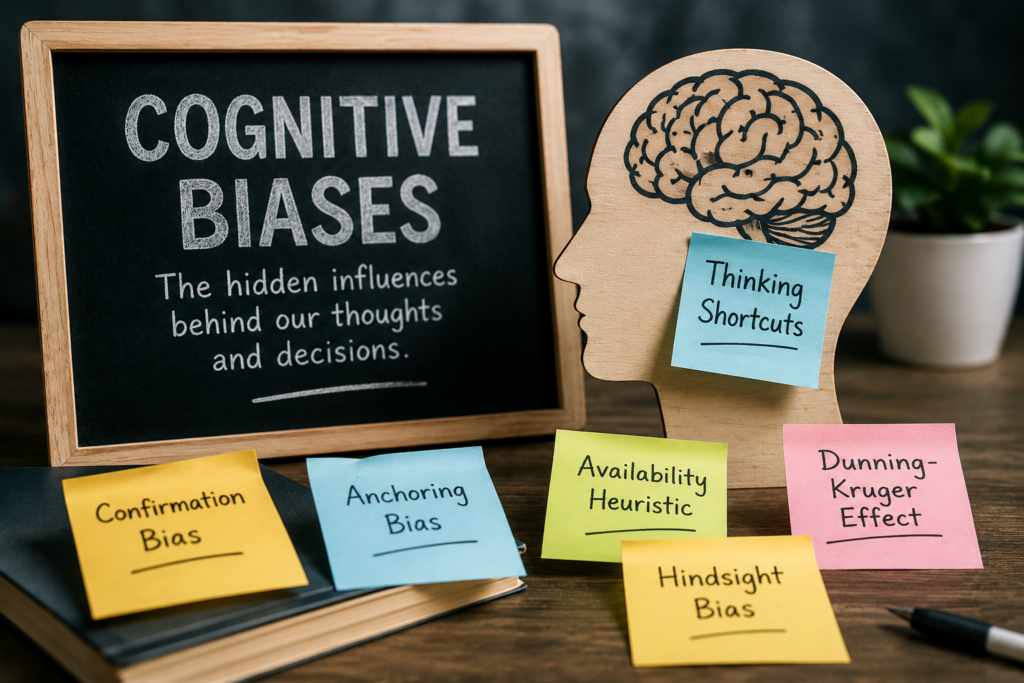
The most 5 common cognitive biases discussed here—confirmation bias, anchoring bias, the availability heuristic, the Dunning-Kruger effect, and hindsight bias—offer a valuable starting point for understanding how the mind works. The more attention we pay to these hidden influences, the better equipped we are to think clearly in a world overflowing with information and opinions.
Daily Dose of Psychology 🧠
Your brain is designed to save effort, not always to find the truth. That’s why cognitive biases exist. One of the most common is confirmation bias, where we naturally notice information that supports our beliefs and ignore information that challenges them. A simple way to think more clearly today is to ask yourself: “What evidence would prove me wrong?” That single question can make your thinking more balanced and accurate.